
Before residents are asked to pay more, Council should show what it can cut, freeze or postpone—and what each choice would actually save.
The Borough’s preliminary 2027 worksheet lists $31,188,140 in spending after identified internal transfers are removed, against $24,234,400 in revenue and other listed funding. The difference is $6,953,740 across all funds, including utilities, capital projects and debt payments. Council needs to close that funding gap; the property-tax decision will depend on the spending it approves and the funding available to each fund. [1]
Start with where the money would go
The proposed spending areas are listed largest first, before related fees, taxes and grants. Some are departments; others are funds or shared accounts. [1]
| Rank | Spending area | Proposed 2027 | What is included |
|---|---|---|---|
| 1 | Police | $5,307,034 | Officer pay, secretary pay, separately shown personnel charges and routine operations; some capital and dispatch costs appear elsewhere. |
| 2 | Administration and shared costs | $4,994,901 | Central employee benefits, pensions, paid-leave wages and general insurance, plus office/legal, codes/zoning, library support and economic-development accounts. |
| 3 | Fire | $4,295,302 | Fire Fund staffing, separately shown benefits and insurance, station maintenance, truck and equipment allowances. |
| 4 | Sewer | $4,042,643 | Collection and pump operations, treatment payments, capital sewer repairs and a $315,000 transfer to the General Fund for overhead. |
| 5 | Water | $2,832,365 | Purchased water, distribution and meter work, labor, equipment/main replacement and a $315,000 transfer to the General Fund for overhead. |
| 6 | Public Works | $2,514,181 | General Fund street, stormwater, tree and building work, engineering, labor, fuel and equipment maintenance. |
| 7 | Capital Projects | $2,132,458 | Architectural/design work, Police vehicles/radios, sidewalks, storm sewers, street reconstruction, equipment and Recreation improvements. |
| 8 | Refuse | $1,973,131 | Refuse/recycling collection, waste fees, leaf collection and disposal, supplies and a $275,000 General Fund overhead transfer. |
| 9 | Recreation | $955,438 | Recreation salaries, pool/playground/tennis staffing, facility maintenance, supplies, utilities, programs and events. |
| 10 | Road Tax | $551,000 | Road reconstruction of $545,000 plus $6,000 of road-tax refunds. |
| 11 | Executive | $508,918 | Manager salary, Assistant Borough Manager/Assistant Secretary and Executive Staff Salaries. |
| 12 | Highway Aid | $495,600 | Snow-removal materials of $91,600, street line painting of $80,000 and street lighting of $324,000. |
| 13 | Finance | $465,412 | Clerks Salaries, Marketing Director and tax-collection commission, supplies, bond and refund accounts. |
| 14 | Parks | $430,423 | Part-time labor, grounds/quarry/Huyett House maintenance, materials, wildlife control and plantings. |
| 15 | EMS | $334,500 | Police and ambulance dispatch, QRS supplies, emergency services and ambulance-service payments. |
| 16 | Debt Service | $259,834 | General-obligation note principal of $179,000 and interest of $80,834. |
The table adds to $32,093,140. It excludes $5,341,294 of General Fund transfers to Fire, Capital and Debt because spending in those receiving funds is already listed. Water, Sewer and Refuse still contain $905,000 of transfers back to General for overhead. Removing those too gives the $31,188,140 total used in our comparison.
Administration is a broad shared-cost group. It includes $3,508,141 of central employee benefits, pensions, paid-leave wages and general insurance, as well as other services. Library support of $265,625 is already inside that entry.
What does Police’s $5.31 million mean?
| Proposed Police component | Amount |
|---|---|
| Officer pay, including overtime, holiday and special-service pay | $2,905,673 |
| Secretary salary | $71,058 |
| Benefits, pensions, employer costs and allowances | $1,932,796 |
| Other operations and equipment | $397,507 |
| Police section total | $5,307,034 |
The 2027 worksheet shows $1,932,796 of Police personnel charges separately, while 2026 benefits remain in central accounts. Council should show how much of the apparent increase reflects moving costs between accounts and how much reflects higher costs. [1]
Some Police costs also sit elsewhere: vehicles and radios in Capital, and dispatch in EMS.
Council should break down the $190,000 Executive Staff Salaries line and $180,000 Recreation Salaries line by position, hours and pay rate.
How would it be paid for?
The proposal draws on property and income taxes, business and other taxes, utility charges, grants, fees, interest and asset sales. Utilities have their own customers, costs and funding restrictions.
| Revenue or other listed funding | Proposed 2027 |
|---|---|
| Property taxes, including General, Fire, Road and EMS | $6,735,100 |
| Earned income tax | $3,700,000 |
| Other taxes | $2,508,400 |
| Utility charges and other operating receipts | $7,791,200 |
| Grants, state aid, contributions and reimbursements | $1,698,700 |
| Other fees, licenses, services, rent, reimbursements and miscellaneous receipts | $1,258,800 |
| Interest | $331,900 |
| Asset sales | $210,300 |
| Revenue and other listed funding | $24,234,400 |
The General Fund—the Borough’s main operating fund—accounts for $6,075,401 of the total $6,953,740 gap. The worksheet leaves that difference open, without an explicit reserve appropriation or new borrowing proceeds. [1]
The Borough’s October 21 Unmet Needs Report separately estimates its existing General Fund structural operating deficit at $2.4 million to $2.7 million. That describes an ongoing operating imbalance; the preliminary all-fund gap also includes capital projects and financing. [6]
Council should also explain whether the $300,000 labeled “Grant—MTF Leftover (Woodland/Wayne)” is a payment still expected or money already received, and whether it remains available for the proposed work.
Spending over time—and why 2024 jumps
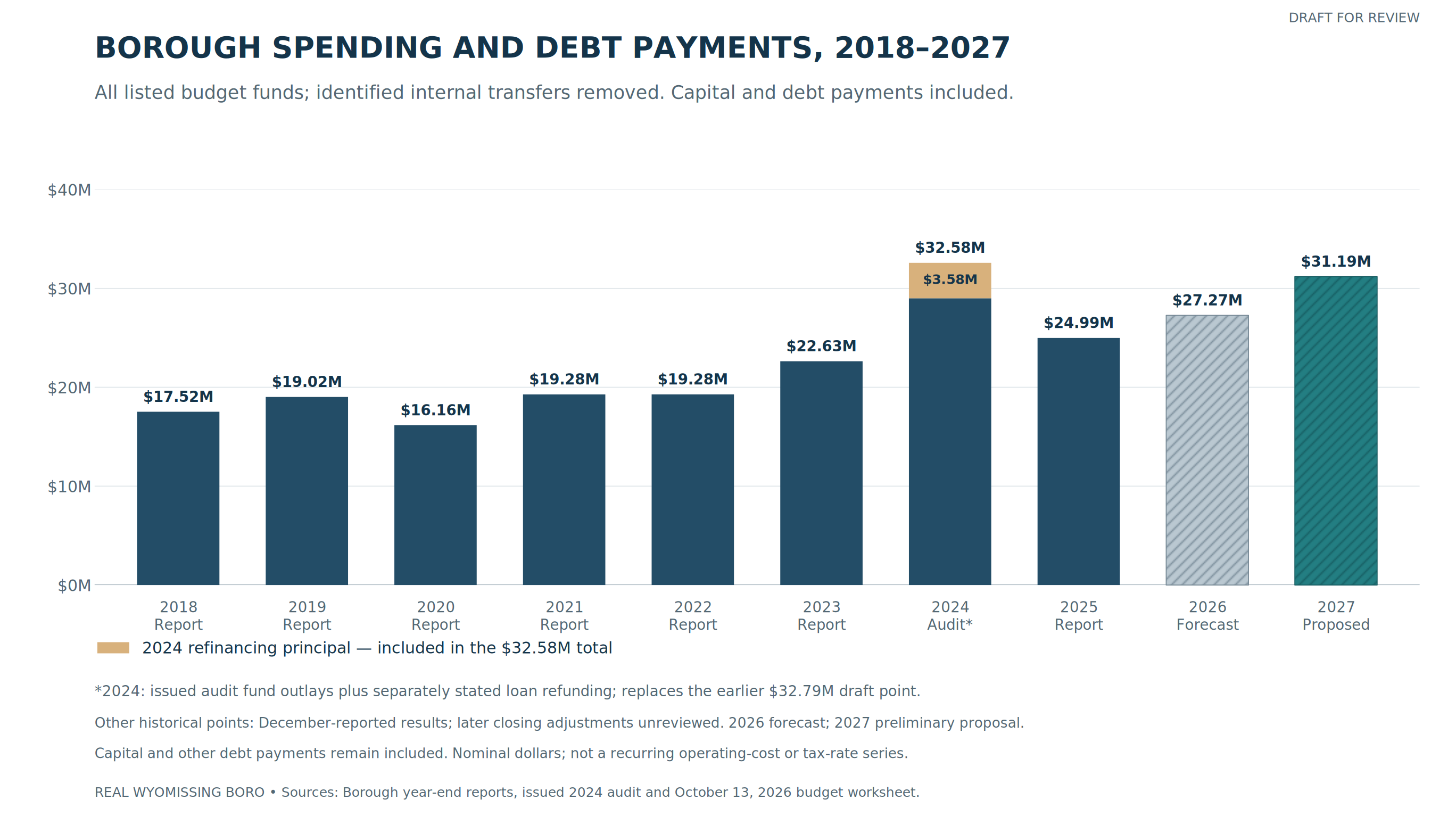
Reported spending was $17.52 million in 2018, $19.28 million in both 2021 and 2022, and $22.63 million in 2023. The 2027 proposal is $31.19 million.
From 2021 to 2025, reported Borough outlays rose from $19,276,535 to $24,990,853—an increase of 29.6%. Over the same period, U.S. consumer prices rose 18.8%. Spending therefore grew about 9.1% after adjusting by that consumer-price index. This comparison uses consumer inflation as a broad benchmark for total outlays, including capital projects and debt. Changes in the mix of projects and services also affect the total. [7]
The issued audit supports $32,584,697 of fund outlays in 2024: $29,001,847 of expenditure plus $3,582,850 used to retire and refinance an earlier note. The graph shows that refinancing separately. The new note’s $5 million balance at December 31, 2024 was outstanding debt. [2]
The garage was a major contributor too. The December capital schedule lists $3,257,702 for it; a wider project worksheet lists $3,460,512 including additional project costs. The schedules cover different costs and still need reconciling into a final project total. The preliminary year-over-year comparison also shows large increases in Public Works buildings/equipment, Fire materials/supplies and Recreation facilities. [3]
For 2026 to 2027, proposed outlays rise $3,913,200 above the full-year forecast, while listed funding falls $2,495,447. The changes include a $2,659,000 RACP reimbursement shown in 2026 but absent in 2027, alongside a $2,644,773 decline in debt spending. Council should separate ongoing operating costs, one-time project funding and debt payments in explaining the year-to-year change. [1]
Cash through the year
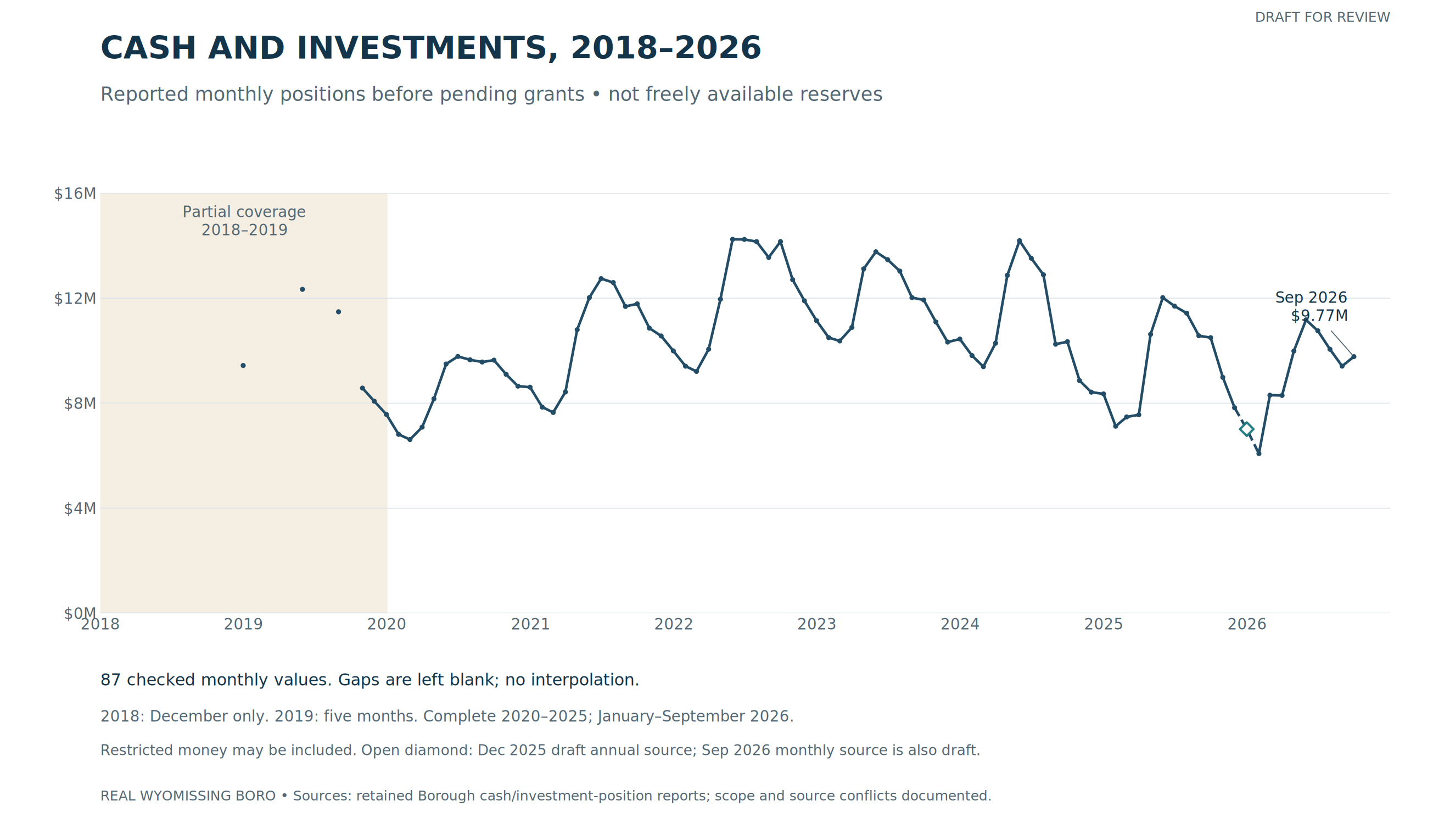
The monthly cash history shows a recurring early-year dip and spring recovery, consistent with the timing of tax collections. Annual reported lows rose from 2020 through 2023, then fell from $10.33 million in 2023 to $8.35 million in 2024 and $7.01 million in 2025. January 2026 was lower again at $6.08 million, within the January–September coverage. [4]
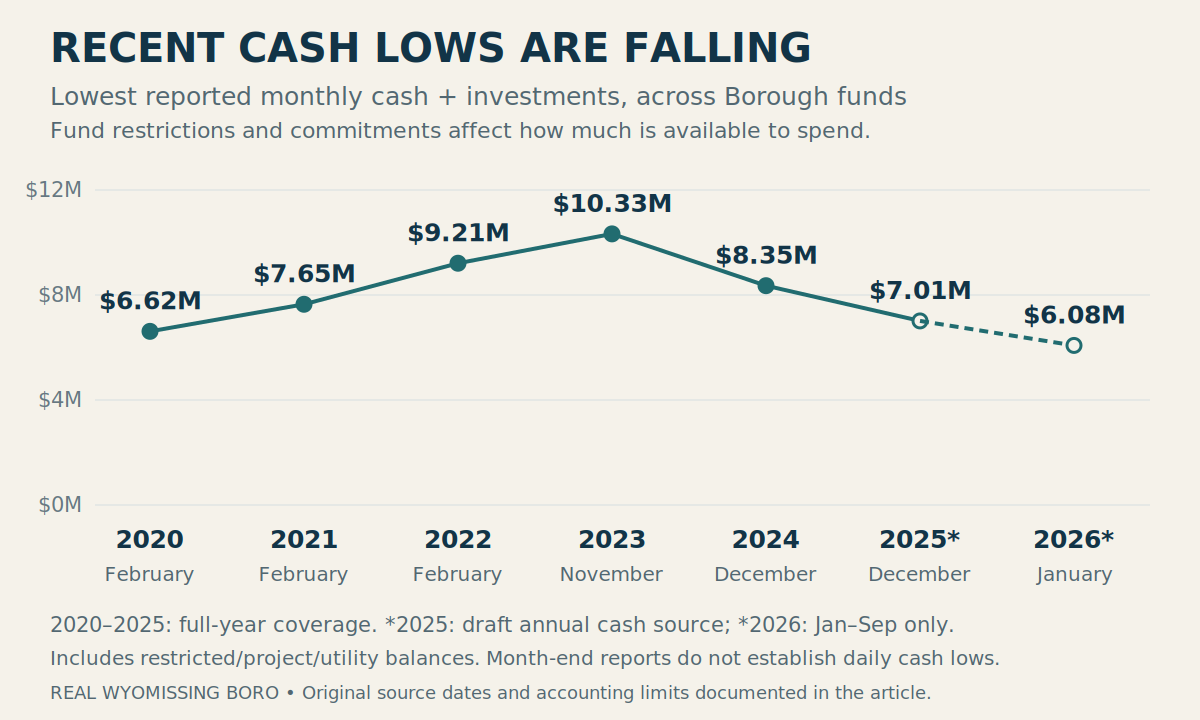
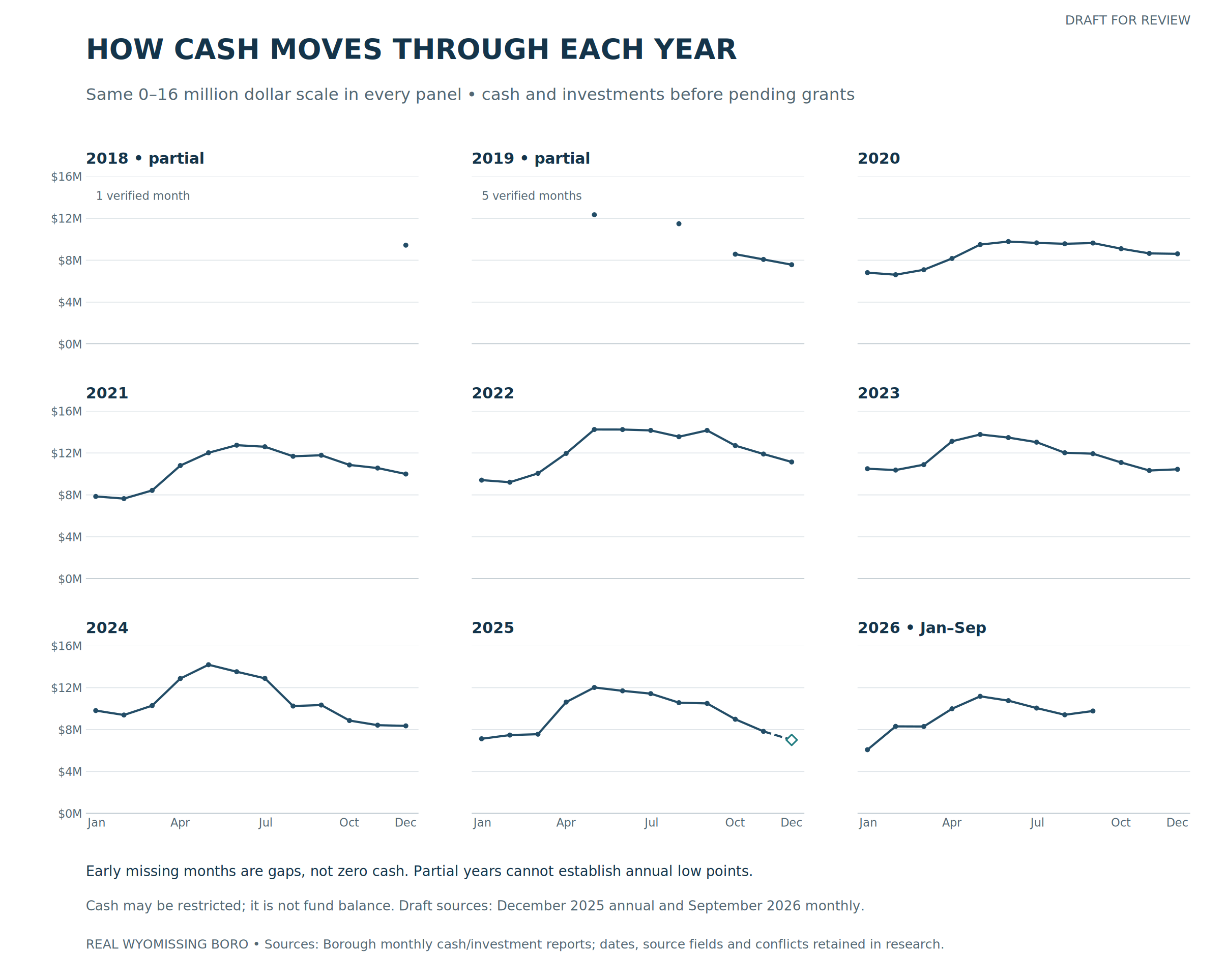
The total includes utility and project balances. Council’s reserve plan should identify the General Fund balance available to use, its existing commitments, and when payments and receipts are expected.
The Government Finance Officers Association recommends an unrestricted budgetary General Fund balance covering at least two months of regular General Fund operating revenue or spending—about 16.7% of the annual amount. Higher reserves may be appropriate where local risks warrant. Council should show its reserve target, the applicable General Fund balance, and how it would replenish any money used. [8]
Pennsylvania’s Act 47 examines signs of financial distress such as expenditures exceeding revenues for three or more years, defaulting on debt payments, or missing payroll for 30 days. Distressed status is determined by the state Department of Community and Economic Development following financial assessment and a public hearing. [8]
Bring choices to the October 28 meeting
The official agenda schedules 2027 Budget Development Presentations for Wednesday, October 28, 2026 at 7 p.m., with public comment before and after the presentations. The Borough’s meeting notice identifies Borough Hall, 22 Reading Boulevard as the location. [5]
- Which spending can Council cut, freeze or postpone, and which commitments prevent a change?
- What would each option save in 2027 and in later years, after any replacement expenses, lost fees or grants, and transition costs?
- Which services, staffing levels, hours or projects would change?
- How much of each apparent increase is a real cost change, a new service, an account transfer or a one-time expense?
- If reserves or borrowing are proposed, which funds can legally supply the money, how long would it last, and how would it be replenished or repaid?
Residents deserve a table of options, with costs and consequences beside them.
Sources and how to read the numbers
[1] Borough preliminary discussion worksheet v4.1, printed October 13, 2026: physical pages 1–18 for spending, transfers and receipts; page 19 for consolidated controls. The official linked file was checked October 26 and matches the retained version. Its heading says “12-Oct-27” while the footer says “Printed 10/13/2026”; we identify this preliminary proposal by version and print date. Open official worksheet.
[2] Historical December reports retained in January Council packets, 2019–2026; the 2024 point uses the issued April 3, 2025 Herbein audit, physical pages 9, 11 and 30–31. The earlier December-draft 2024 result was $32,788,912; its $204,215 difference from the audit-derived result remains unreconciled. Other historical values retain their reported year-end status. The 2023 point follows the consolidated transfer control, which is $229 above the utility-detail sum; this unresolved source difference leaves the displayed $22.63 million unchanged. The bars use each year’s dollars; the separate CPI comparison is explained in note [7]. Open selected historical pages. Open issued 2024 audit excerpts.
[3] December 31, 2024 Finance reports for January 9, 2025: physical pages 4–5, 18 and 30 for financing and garage context; January 14, 2025 Council packet, physical pages 115–120, for the preliminary year-over-year category comparison. These category figures explain the December-report spike. The project amounts are already included in reported spending. Open garage and financing excerpts. open January 14 packet at physical page 115.
[4] Borough cash/investment-position reports and dated comparison columns, 2018–September 2026. The series follows contemporaneous cash-plus-investment positions where later comparison columns conflict. Pension and separately identified escrow holdings are excluded; the restrictions on listed accounts require separate confirmation. The February 2024 source labels its column February 24; a later original comparison labels the identical amount and components February 29. December 2025 uses provisional evidence from the draft annual cash statement and investment note: the cash line and notes agree, but other statement totals remain unreconciled. The September 2026 report is also marked draft. The open diamond identifies the December 2025 substitution from an annual statement. Month-by-month cash sources.
[5] October 28 official Council agenda for the time and business; the Borough’s meeting notice (calendar event 1319) for the location. The agenda’s 7 p.m. time is used; the separate budget-calendar listing still says TBA. Check the official agenda for updates before attending. Open official agenda. Open Borough meeting notice.
[6] Borough Unmet Needs Report, October 21, 2026, physical page 4 (printed page 3): the Borough’s estimate of its existing General Fund structural operating deficit. Open official report.
[7] BLS CPI-U, U.S. city average, all items, not seasonally adjusted, series CUUR0000SA0: annual averages 270.970 in 2021 and 321.943 in 2025. Cumulative inflation = 321.943 / 270.970 - 1; CPI-adjusted spending growth divides the spending ratio by the CPI ratio. CPI measures consumer prices; municipal purchasing costs can follow a different pattern. BLS published the 2025 annual average with October unavailable because of a lapse in appropriations. Baseline matters: 2019–2025 outlays rose 31.4% versus CPI 25.9%, or 4.3% after CPI adjustment. BLS annual table BLS monthly table and data-gap footnote
[8] Government Finance Officers Association, Fund Balance Guidelines for the General Fund: recommended unrestricted budgetary General Fund balance. Pennsylvania Municipalities Financial Recovery Act (Act 47), sections 121, 201 and 203: state assessment, financial-distress criteria and the determination process. The examples above appear in section 201(2)–(4). GFOA guidance Act 47 official text
- Official preliminary worksheet
- Borough budget information center
- October 28 Council agenda
- Selected historical, audit and garage source pages
- Cash by year: matching-scale graph
Real Wyomissing Boro is independent and is not affiliated with the Borough of Wyomissing.