
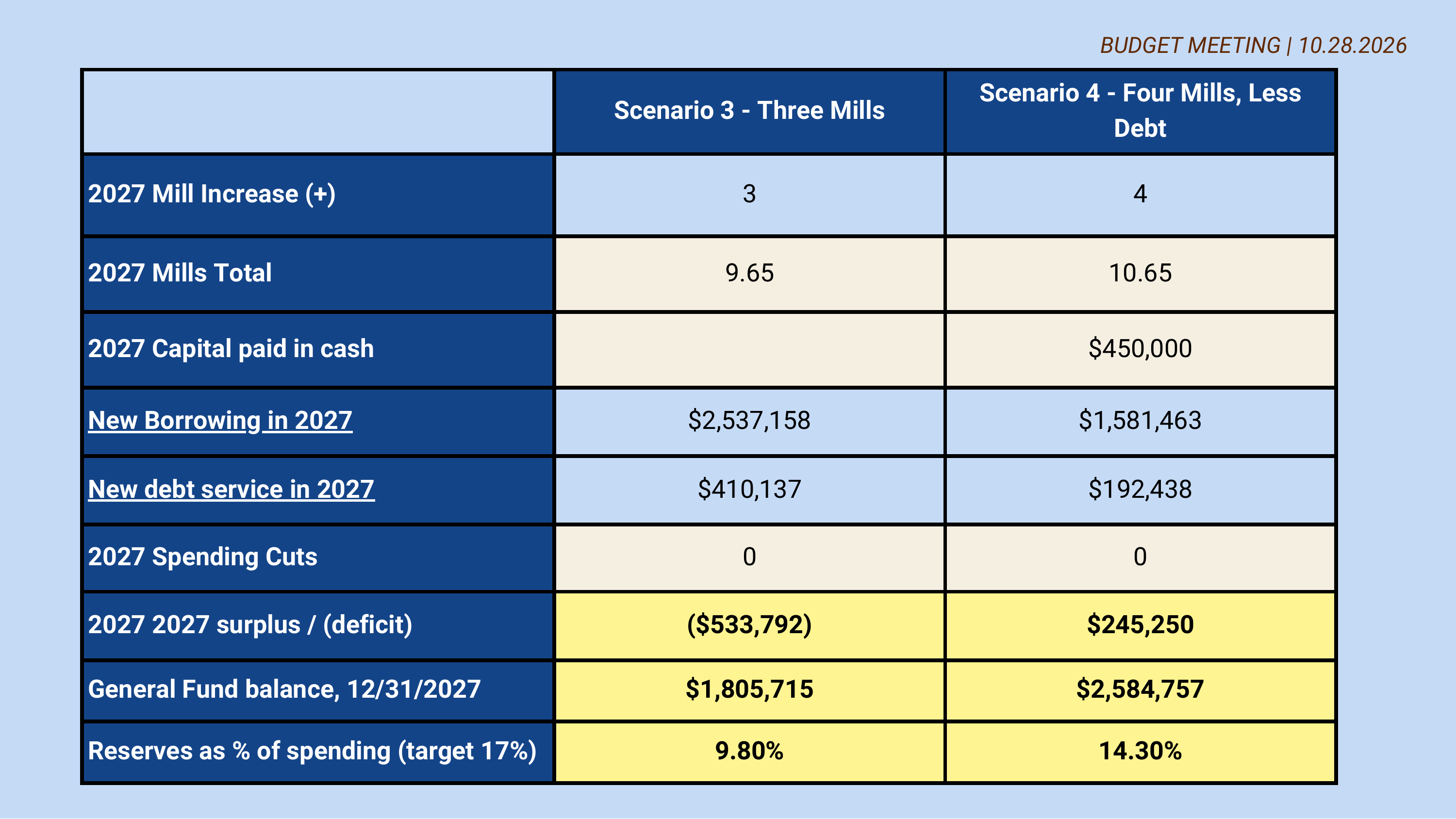
Three more mills would raise Wyomissing’s Borough property-tax rate by 45.1%. In the Borough’s published borrowing scenario, it would also mean $2.54 million in new debt—and a $533,792 General Fund shortfall for 2027. [1][2]
These are proposals for the 2027 budget. Interim Borough Manager Eden Ratliff recommends focusing on three- or four-mill options with borrowing. Council has to decide what to fund, what to cut and how residents would pay. The General Fund is the Borough’s main operating account. [1]
The higher bill still leaves a gap
Three additional mills would take the Borough rate from 6.65 to 9.65. Four would take it to 10.65—a 60.2% increase. For every $100,000 of assessed property value, that means another $300 or $400 a year. County and school taxes are separate. [1]
The three-mill borrowing case shows a $533,792 annual deficit. The four-mill case shows a $245,250 surplus, but funds $505,695 less capital and uses $450,000 in cash. They are different packages, not an identical set of projects financed two ways. [1][2]
Both columns list zero under “2027 Spending Cuts.” That describes these modeled options; it does not erase earlier budget revisions or Council’s later discussion of reductions. Both also end below the comparison’s stated 17% reserve target: 9.8% with three mills, 14.3% with four. [2]
Borrowing moves the bill
Ratliff’s October 28 memo makes an important distinction:
“Borrowing can help finance major capital improvements, but it does not solve the operating deficit.”
— Eden Ratliff, interim borough manager, budget memo, page 1 [1]
Management argues that borrowing spreads the cost of long-lived assets across the taxpayers who benefit. It also commits future budgets to repayment. The scenarios already include $410,137 in new debt service for 2027 under three mills, or $192,438 under four. Those are debt payments, not interest alone. [1][2]
Future tax rates will depend on spending, other revenue and reserves as well as debt payments. Borrowing alone does not close an operating gap. Future budgets must cover repayment alongside ongoing services, through recurring revenue, savings or both. The missing comparison is the full repayment schedule, interest, fees and future tax-and-reserve forecast. [1]
Five proposed positions need a net price
The presentation lists an administrative assistant, zoning/code officer, permit coordinator, accounts-receivable clerk and deputy fire chief. The larger displayed figures total about $665,000. That is a gross estimate, not verified net additional spending. [2]
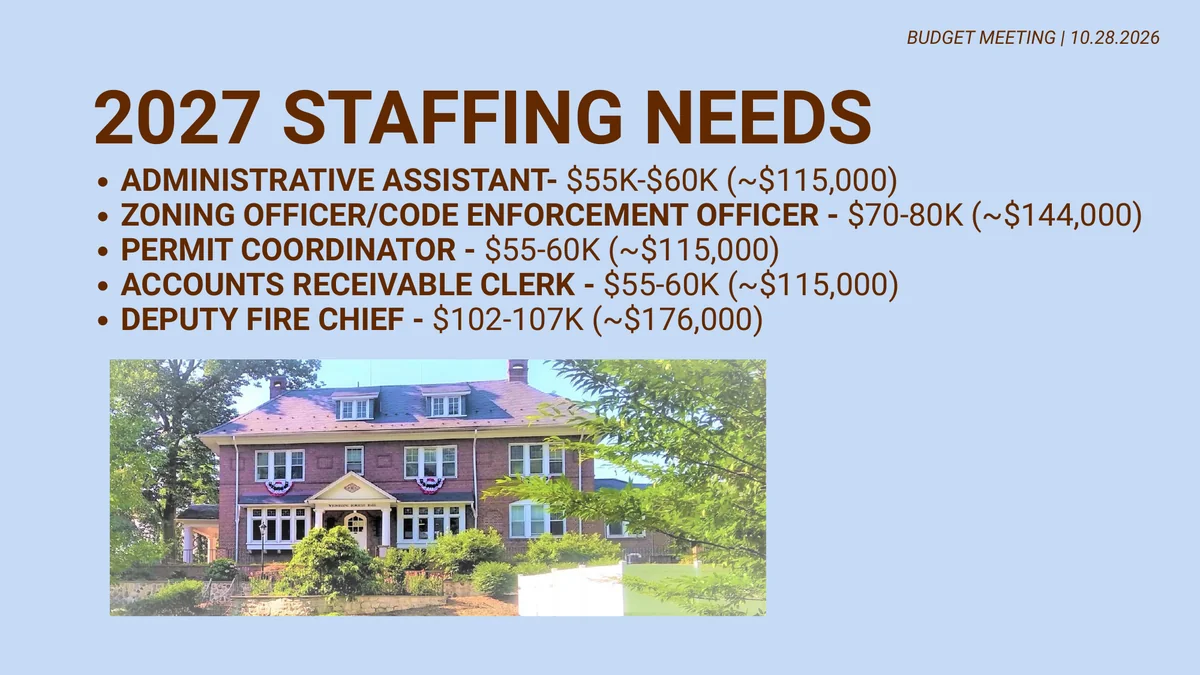
The useful calculation is what each role adds after outside work ends, when hiring begins and what the next full year costs. The organization chart labels the Assistant Director of Public Works as existing; that role should not be counted as a new hire. [2]
The written proposal separately allocates $350,000 for management, $250,000 for finance and $160,000 for communications/marketing/PR. Those $760,000 in proposed allowances need defined deliverables, billing limits, measurable results and an end point for interim arrangements. [1]
Council owns the long-term decision
An interim manager can recommend borrowing. Council is responsible for the decision to authorize it. Ratliff’s memo calls the borrowing amounts preliminary and says Council would approve a five-year capital plan before a bond issue. Council owes residents a repayment plan and a clear timetable for moving out of interim management. [1][6]
The preliminary proposal totals $30.25 million across the listed funds, nearly $3 million above the 2026 full-year forecast. That comparison removes identified internal transfers but still includes utilities, capital and debt. It is broader than the General Fund and does not measure recurring operating growth alone. [3]
At the October 28 meeting, Council discussed $200,000 to $300,000 in possible additional operating cuts and asked Eden Ratliff to show which services those cuts would affect. The next step is to put net savings, lost revenue, timing and service effects beside every choice. [4]
The meeting continues November 3 at 7 p.m. at Borough Hall, 22 Reading Boulevard. Residents need the lower-spending choices before Council chooses a tax rate—not just different ways to finance a larger bill. [5]
The records behind this article
- October 28 budget memo and funding scenarios. Ratliff’s role, recommendation, operating/capital distinction and proposed capital-plan approval: pp1–4; scenario outcomes: p5; management/finance allowances: p7; PR allowance: p9. Read the 27-page packet.
- Borough presentation. Staffing p13; organization p14; three-/four-mill comparison p26. The two displayed images show the complete presentation pages. Official 29-page presentation, exported October 29. The slide’s communications estimate is $158,400; this article uses the written budget’s $160,000 allowance. Read the complete 29-page presentation.
- All-fund spending comparison. Detailed budget pp13–23. Calculated external outlays: 2026 forecast $27,274,940; 2027 proposal $30,245,105; difference $2,970,165 (10.9%). General Fund outgoing transfers and utility overhead transfers are removed to avoid counting the same internal movement twice. View the underlying fund totals.
- October 28 meeting recording. Closing discussion about returning with operating-cut options and their effects. Watch the recording.
- Reconvened meeting agenda. November 3, 7 p.m.; budget presentations and public comment before and after. Read the official agenda · Meeting location and notice.
- Pennsylvania Local Government Unit Debt Act. Governing-body borrowing authorization and repayment provisions, §§8102–8104. Read the statutory provisions.
- Average-house calculation. Our analysis of Berks County CAMA data retrieved October 21, 2026: 3,056 current 2026 Wyomissing residential parcels with one-family land-use codes, one recorded living unit and positive assessment. Total assessment $512,409,600; mean $167,673.2984. The group includes attached/row houses and excludes condos and multifamily records. The tax examples use the unrounded mean × added mills ÷1,000, rounded to cents. Information is based on geospatial data from the County of Berks. County assessment data source.
Real Wyomissing Boro is independent and is not affiliated with the Borough of Wyomissing.