Wyomissing residents deserve to know what extending the proposed passenger train beyond Reading would add, what it could cost, and how passengers would get to and from it. Fred Levering’s determination is easy to hear. The station case still needs to be shown.
At the Berks County commissioners’ October 14, 2026 town hall at Wyomissing Public Library, Levering again said the train from New York “ought to come over to Wyomissing.” Audience laughter followed. He went on to point to activity in Spring Township and West Reading and argue that the railway’s expense made a Wyomissing endpoint its best chance of success.
Five years earlier, at the library’s candidate forum, he had pledged: “It needs, it must come to Wyomissing, and I will not rest until it does.” [7]
Five years of insistence should produce more than another speech. Residents should be able to see the proposal, the additional passengers it would attract, the access arrangements and the bill.
The 2026 argument, beyond the laughter
Read the clip transcript
We’ve got a lot of stuff going on and I need to mention, Christian never heard me say this before. I think the train from New York ought to come over to Wyomissing. (laughter)
We’ve got a lot of stuff going on and in conjunction with really interesting things happening in Spring Township at the Broadcasting Road and great things in West Reading at Penn Avenue. This is where the action is!
And I think the enormous expense of the system of establishing the train, we need to give it its best opportunity of success, and that means coming over here and not ending in Reading.
What SRPRA is actually developing
The Schuylkill River Passenger Rail Authority is the regional sponsor, established by Berks, Chester and Montgomery counties. It is developing an intercity passenger-rail service through the Federal Railroad Administration’s Corridor ID program, with Amtrak as the proposed operator. This is a regional project involving host railroads and public agencies; a Wyomissing mayor cannot decide its endpoint by declaration. [10] [17]
The August 25 fact sheet supplied by executive director Tom Frawley envisions up to seven daily Reading–Philadelphia round trips, three continuing to New York in the initial service phase. Frawley confirmed to us on August 26 that those New York trips are intended as one-seat rides from the start. No Philadelphia train change is planned for those trips. [10]
We reported that update on Facebook in August. [9] The same fact sheet places additional frequencies in a later phase, with Allentown and Harrisburg among longer-term possibilities. Fares remain undecided; the working comparison is Amtrak’s Keystone Service. These are service assumptions, not an operating timetable. [10]
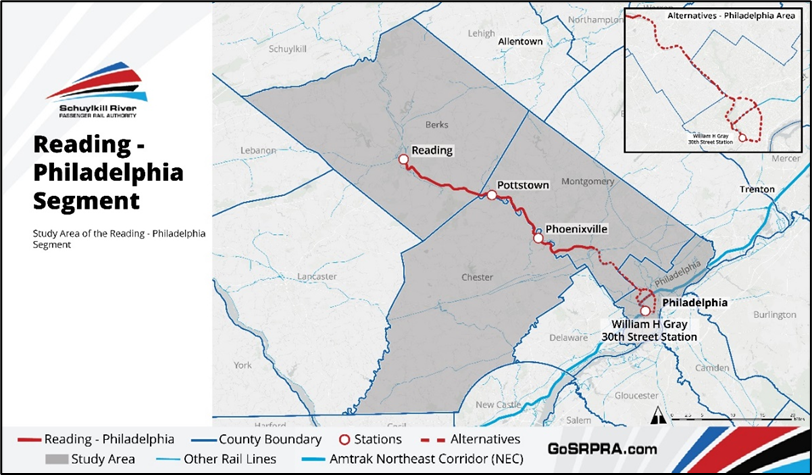
The initial station list names Reading, Pottstown and Phoenixville. The exact alignment remains under development. SRPRA’s FAQ identifies Franklin Street as Reading’s recommended initial site in a paragraph expressly dated July 1, 2025; that is a recommendation, not a final station approval. [1]
Planning progress is real. Construction is another stage.
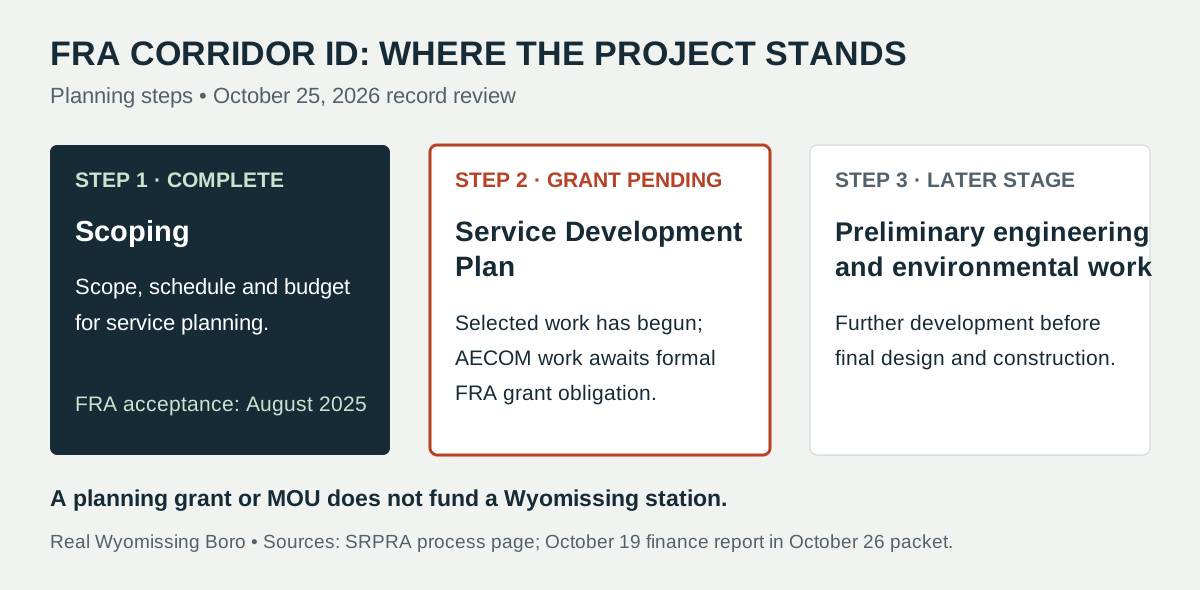
SRPRA dates FRA’s acceptance of the scope, schedule and budget for preparing the Service Development Plan to August 2025. Selected preliminary Step 2 work began in early 2026, including Amtrak ridership and revenue forecasting. The full Service Development Plan is the next major planning product. [2]
The latest checked finance report was prepared October 19 for the October 21, 2026 finance meeting. Included in the October 26 board packet, it still reports AECOM activity on hold pending formal obligation of the FRA Step 2 grant. September’s draft minutes describe SRPRA and Amtrak continuing preliminary work while that formal advancement was awaited. Formal obligation of the Step 2 planning grant remains the outstanding milestone reported there. [4]
There is also an Amtrak agreement, but its purpose matters. The supplied fact sheet dates the memorandum of understanding to June 23, 2026; SRPRA announced it July 15. The announcement confirms the proposed operator and selected ridership, revenue and operating-cost work at no cost to SRPRA. It is a planning commitment. It does not establish a construction award, a finished operating agreement or permission to use a particular station site. [10] [3]
The October 26 agenda proposes further Amtrak operations modeling with Norfolk Southern and SEPTA using Local Share Account grants. As of October 25, that is a proposed board action. It illustrates the operational work still required before an opening date can be promised. [4]
Intercity service still needs a station case
The proposal is Amtrak intercity service, rather than a return of the former SEPTA commuter operation. Intercity planning has to evaluate the service as a whole: demand, running times, freight capacity, infrastructure and cost. Using SEPTA tracks on a possible alignment would not make SEPTA the operator. [2]
But “intercity” does not, by itself, rule out an additional stop. SRPRA’s own FAQ leaves additional stations open to evaluation through service planning and ridership analysis. What would a Wyomissing station add, and would that benefit justify its costs? [1]
SRPRA has addressed Wyomissing directly before. Reading’s April 22, 2024 official meeting summary records Frawley saying a Wyomissing station was not then under consideration, while leaving a future station possible after the initial scope and service expansion. That is a dated statement, not a permanent prohibition. What proposal or decision has changed the position since then? [5]
The medical-school argument needs numbers
In 2021, Levering connected his station preference to Drexel, Tower Health and Philadelphia. That was an argument about possible travel demand. It was not a calculation of the additional demand created by extending beyond Reading.
Read the clip transcript
We have a connection with Drexel doing the medical school in conjunction with Tower. They have a campus here now, and they have one across the street from 30th Street Station in Philadelphia, which is one of the proposed stops.
Tower has recently announced that they’re going to have an affiliation with Penn. And Penn is next door to Drexel. So I think that in order to fully maximize the impact of that medical school, it needs, it must come to Wyomissing, and I will not rest until it does.
The medical school was a real development: Drexel’s own account says its four-year regional campus opened in 2021 and welcomed an inaugural class of 40 first-year students. Those 40 students are not a rail-ridership forecast, and a medical-school connection is not proof that Wyomissing is the best terminus. [6]
A student, employee or visitor using a Reading station would also gain a connection to Philadelphia. To establish an added Wyomissing benefit, show how many more people would ride, how they would reach the platform, how much travel time they would save and what the extension would cost. That comparison has to account for walking, buses, parking and other ways passengers would actually reach either station.
The same gap appears in the 2026 speech. Levering points to Broadcasting Road in Spring Township and Penn Avenue in West Reading. “This is where the action is”? Those are examples of activity in neighboring municipalities. Listing them does not identify what Wyomissing or Levering has delivered—or demonstrate why a Wyomissing endpoint would serve the regional market better than Reading.
The Borough’s own WyoWays account identifies redevelopment at the Knitting Mills, Teleflex and the medical school, together with actual road improvements. Those are specific projects that can be examined. They do not automatically establish a station case, and the location argument still needs a comparison of passengers, access and cost. [21]
How would passengers get to and from the station?
Take someone coming from Broadcasting Road in Spring Township. Which roads would they use, where would they enter the site, and where would they park or be dropped off? What would the trip involve on foot or by bus? How would the time, cost and convenience compare with using the proposed Reading stop?
A credible forecast needs to distinguish additional riders attracted by a Wyomissing station from passengers who would otherwise board in Reading. Then weigh that benefit against the added infrastructure, operating costs and timetable effects. An intercity plan should use its actual proposed frequencies and fares, rather than assume a frequent suburban commuter service. People can commute on intercity trains; the service model and the demand assumptions still have to match.
Amtrak’s station guide prioritizes pedestrian and public-transit connections and relates parking provision to projected demand. For passengers arriving by car, show the spaces, drop-off arrangements and route through surrounding intersections. For everyone else, show the bus connection, safe walking route and accessible path to the platform. A parking lot visible on a plan is not proof that passengers have permission to use it. [19]
The road constraints are documented. The MPO’s plan, adopted November 13, 2025 using 2024 traffic data, identifies high congestion on State Hill Road between Keiser Boulevard and Penn Avenue, and on Penn Avenue between State Hill and Reading Boulevard and between 8th and South 4th Avenues. Those findings make a station’s traffic effects worth testing; they do not predict those effects. [20]
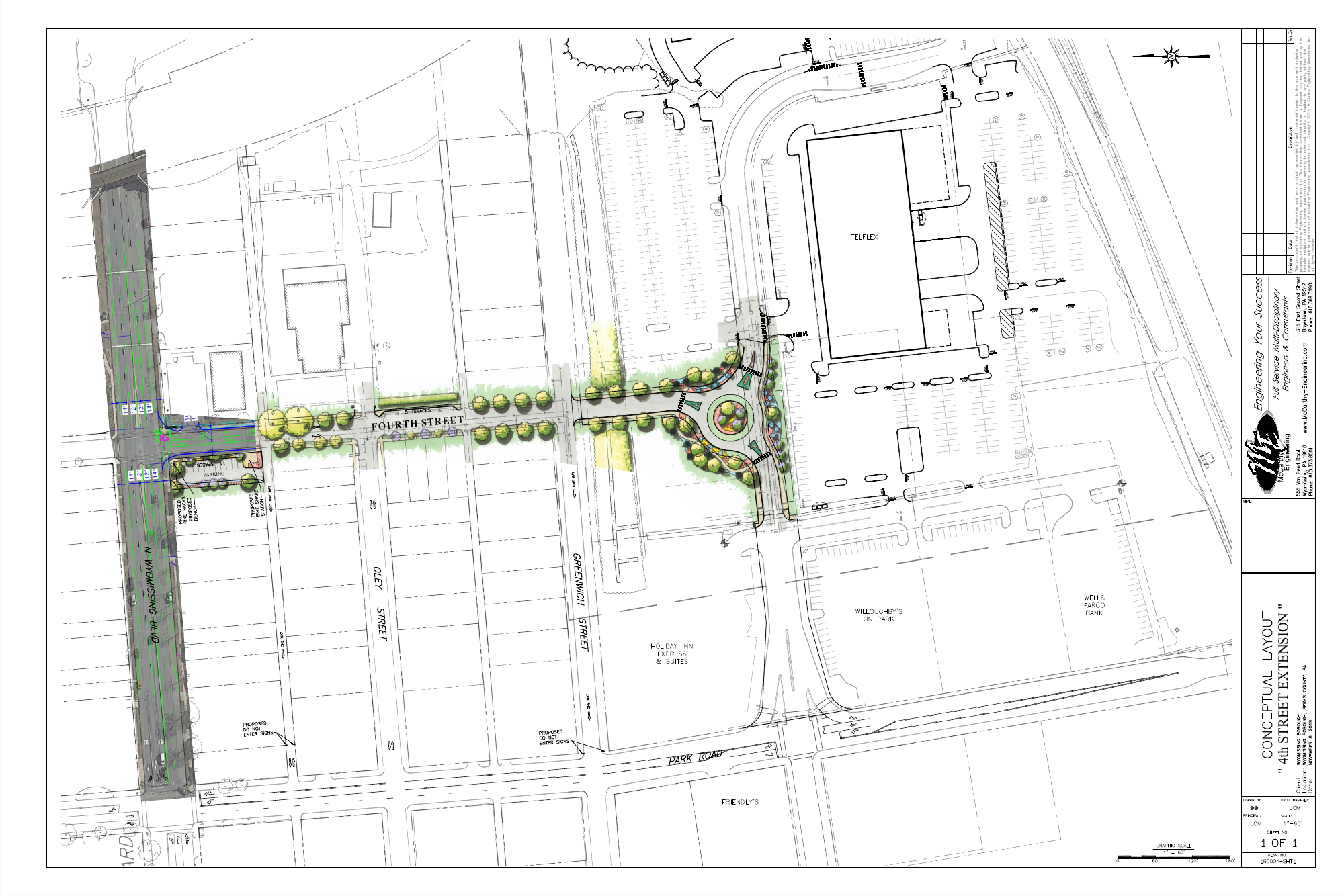
There are other connections to examine, too. The Borough reports that the Fourth Street extension opened in 2021, linking Innovation Way toward North Wyomissing Boulevard, and describes improvements intended to ease access from Route 422 to the Knitting Mills. A station access plan needs to show how those links and surrounding intersections would handle its passengers. Getting to the surrounding redevelopment also does not establish the right or ability to reach the proposed platform. [21]
Access has been raised for years. The March 2022 minutes discuss a one-lane bridge, heavier vehicles and emergency access; February 2026 draft minutes still record pedestrian and emergency-access concerns for the former powerhouse site. The issue is what has been resolved and documented. [12] [22]
Other studies cannot fill that gap automatically. The neighboring apartment application had a November 2024 traffic analysis; TPD’s January 2025 review said its traffic comments were addressed. That finding concerns the apartment plans, not a passenger station’s traffic, parking or demand. [23]
Nor is this the first time a Wyomissing station has been examined. A 2008 R6 commuter-rail study considered access, parking and freight conflicts at a different station concept south of the railroad. Its meeting note names Levering among participants in April 2008. That history needs to inform a current proposal; it cannot substitute for a current Amtrak forecast or today’s site and access agreements. [24]
Publish the station-specific package: a comparative ridership forecast, traffic and parking analysis, passenger and emergency-access arrangements, and the agreements allowing public use. That is how residents can judge whether enough additional passengers and benefits justify the cost. “The action is here” does not answer any of those questions.
The records contain a concept—and unresolved work
The Borough’s minutes show how long the concept—and its practical problems—have been discussed:
| Record | What it establishes |
|---|---|
| August 2020 | Levering reported discussions with Equus about a powerhouse station, bridge work, developer construction or leasing and possible renderings. [11] |
| March–July 2022 | He gave an approximately $4 million new-bridge estimate, alongside other bridge and utility work. Later he corrected an assumed second access: the relevant land was not owned by Equus. [12] [13] |
| January 2025 | The committee discussed possible tax-increment financing, grants, a second access and potential Borough costs beyond grants. That discussion does not establish adopted station financing. [14] |
In the records reviewed, I could not trace that concept to an accepted Wyomissing station package with executed site and access agreements and committed financing. The documents establish a concept and advocacy; they do not establish a station ready to be delivered.
Who would pay?
SRPRA describes local entities as generally leading station facilities, with authority support and separate responsibilities for some work within railroad property. Norfolk Southern’s general station principles require operational evaluation and place station-related costs on the station sponsor and other parties, rather than the freight railroad. Land, bridges and passenger access are not free additions to a route map. [2] [8]
The authority has identified county and grant funding for its operations and planning. That is not evidence of a Wyomissing station award. A credible local proposal needs a total budget, named funding sources and a clear allocation of construction, maintenance and continuing costs.
The Borough’s October 21 report estimates a $2.4–$2.7 million structural General Fund operating deficit entering the 2027 budget process. Borough records also indicate about $2.06 million in principal remained on its 2024 general obligation note as of September 30, excluding future interest. [18] Any proposed local station commitment needs the same scrutiny as other spending: what would residents pay, what else would be deferred, and what ongoing obligation would follow? [15] Our budget reporting explains the wider affordability problem.
Show what the advocacy has produced
A mayor can advocate for a better project. Advocacy also carries a duty to explain the evidence. His insistence has outlasted the explanation residents need: why Wyomissing would be the better investment.
Put the dated proposal and agency response on the table. Show the site-control and access agreements, the station’s traffic and parking analysis, the additional-ridership comparison, the full cost and the parties committed to paying it. Trace the whole trip to the platform, not just the train’s arrival.
Where’s the plan? The money? The benefit?
Sources and scope
Sources checked October 25, 2026. This review distinguishes a regional service plan, local station advocacy, and secured station commitments. The land/access review is bounded to the identified records; it is not a complete title search. Recordings retain the order of the selected remarks and reaction. The linked local-record excerpts preserve the cited source pages; two residents’ street addresses are redacted. Original-page references below differ from the excerpt packet’s PDF page numbers.
- SRPRA’s current FAQ. Checked October 25. Initial station list and additional-stop evaluation; Franklin Street recommendation expressly dated July 1, 2025. Exact alignment and station approval remain distinct.
- SRPRA’s project process. Checked October 25. FRA program, participants, station roles and planning milestones. Its older New York phase graphic conflicts with the newer supplied fact sheet; this article uses Frawley’s August clarification.
- July 15 Amtrak planning announcement. Two-page public announcement, especially p. 2. It describes the planning MOU; the linked document is not the signed instrument.
- October 26, 2026 SRPRA board packet. Agenda p. 2; September 28 DRAFT minutes pp. 6–7; finance report prepared October 19 for October 21, pp. 10–11. October 26 actions are proposed as of this review.
- Reading’s April 22, 2024 official summary, pp. 3–4. City Clerk summary, not a verbatim transcript or a current permanent rejection.
- Drexel’s 2021 campus-opening account. Contemporaneous account of the four-year campus and its first cohort; not a transportation-demand study.
- Full October 19, 2021 library forum. Video courtesy of Wyomissing Public Library, used with permission; the full recording provides the surrounding context.
- Norfolk Southern’s August 30, 2018 station principles. General policy, pp. 2–3 and 7. It is not a site-specific Wyomissing ruling.
- Our earlier Reading–New York Facebook update. Link sent to Frawley August 31. The earlier coverage was a Facebook update.
- August 25, 2026 SRPRA fact sheet, Rev. 2. Supplied directly by Frawley in a native DOCX whose filename retains DRAFT/Rev. 2; the linked PNG is the retained reference image. He confirmed the intended one-seat New York service August 26 and reviewed the proposed post August 27. These service assumptions remain subject to development.
- August 27, 2020 Economic Development minutes, p. 2. Original approved meeting record. Developer interest and prospective work are distinct from executed agreements.
- March 31, 2022 Economic Development minutes, pp. 1–2. The bridge figure is a historical estimate for new bridge work, not a current all-in station estimate.
- July 21, 2022 Economic Development minutes, p. 2. Historical ownership/access correction; not a complete current title or easement opinion.
- January 30, 2025 Economic Development minutes, p. 4. Possible funding mechanisms discussed; no adopted station TIF, fixed Borough share or award established by this record.
- October 21, 2026 Borough unmet-needs report. Operating estimate for the 2027 budget process; not debt or an adopted station expense.
- Our current Borough budget analysis. Related reporting; station costs must be evaluated separately from the Borough’s existing operating problem.
- FRA Corridor Identification and Development Program. Federal intercity passenger-rail planning framework. Program participation is distinct from construction funding or station approval.
- Dated note-principal calculation: $5,000,000 less reported $173,000 in 2025 and $2,763,525 through September 2026 = $2,063,475, rounded. 2024 issued audit, Note 5; 2026 Draft 5 worksheet, actual 2025 principal; 2027 v4.1 worksheet, actual through September 30; May payment records corroborate the grant-funded paydown. This is a calculated balance on one note as of September 30, excluding future interest—not a current lender payoff or all-liabilities total.
- Amtrak Station Planning and Development Guidelines, January 2022, V.4. Physical pp. 71, 85, 88, 93 and 134. General guidance on projected ridership, transit/pedestrian connections, parking demand, accessibility and emergency access; not a Wyomissing approval.
- Reading Area Transportation Study Congestion Management Process, adopted November 13, 2025. Physical pp. 35, 82 and 98 / printed pp. 25, 72 and 88. Corridor measures use 2024 data. These findings concern the identified street sections, not traffic generated by a proposed station.
- Borough WyoWays project account and Fourth Street concept. Historical page describes July 30, 2021 road opening and access improvements. The accompanying November 6, 2019 McCarthy concept is a road layout, not an as-built survey or station plan.
- February 26, 2026 Economic Development DRAFT minutes, p. 3. Retained complete draft from the March packet; records pedestrian/emergency concerns, not a determination that lawful access is impossible.
- January 30, 2025 TPD traffic review, p. 1. Reviews a November 2024 Bogia Traffic Impact Analysis and January 17, 2025 revised plans. All traffic comments were reported addressed. This is the apartment application; underlying traffic analysis was not independently read in this review.
- July 10, 2008 R6 Norristown Line Service Extension Study. Physical pp. 85–89 / printed 6-44–6-48, especially Figure 6-22 and footnote 8. Older commuter study and different south-of-railroad station concept; not current island rights or Amtrak demand. Forecast tables for other corridor scenarios do not supply a current Wyomissing intercity ridership forecast.
- July 31, 2022 Borough financial and pension report, assessment-civil-suits table, physical p. 16. The table labels the property Berkshire Mall: $14,928,000 previous assessment, $7,800,000 court stipulation, $7,128,000 decrease and $32,076 reduction to current tax. It lists a June 14, 2022 court order and June 24 processing. This is the Borough report, not the underlying court order or a verified total for every mall parcel.
- 2023 Budget Assumptions DRAFT 2, abstract-values table, physical p. 2. COMM category: $393,277,500 at October 21, 2021 and $414,970,700 at October 20, 2022, increase $21,693,200. These are recorded assessment snapshots, not a commercial floor-area, vacancy, jobs or ridership series.